

An Interview with Kevin Helm
An Interview with Kevin Helm

An Interview with Kevin Helm
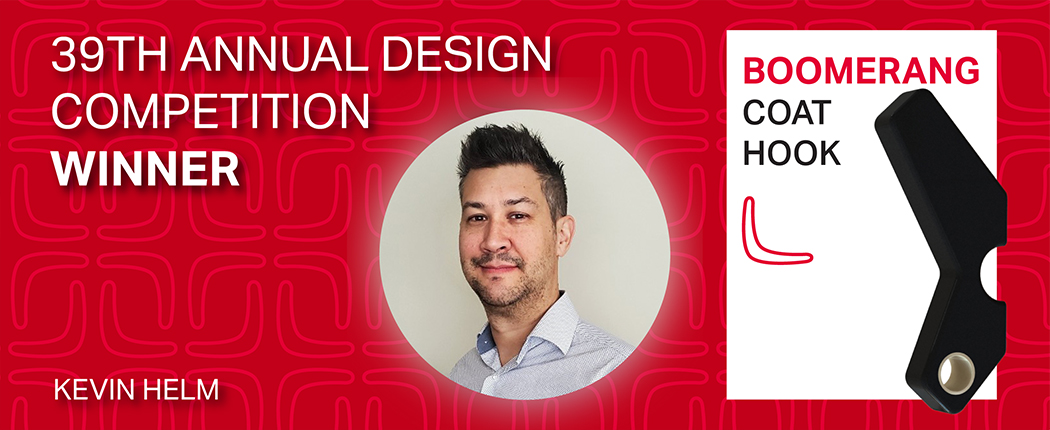
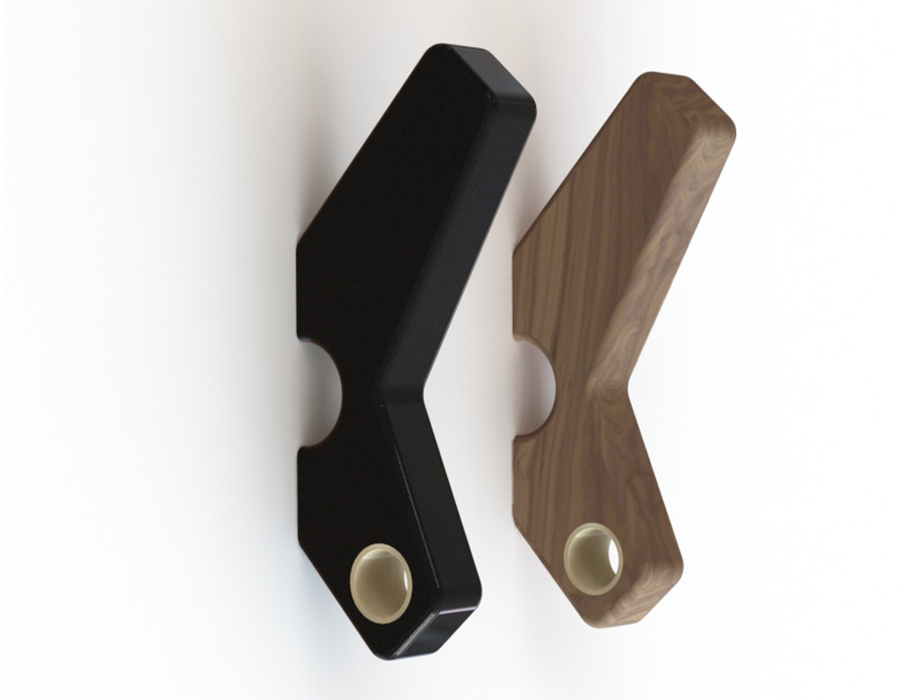
Kevin Helm is the owner and designer of 2Point54 Designs. After spending years in oil and gas marketing, Kevin sought to foster his creativity, went to school, and started his own business. His solutions reflected the high-quality designs that his grandparents' furniture was crafted with. Inspired by those principles and the silhouette he saw of an axe against the wall, he created the “Boomerang” coat hook.
What is your background in design? What led you to our Annual Design Competition?
My name is Kevin Helm, and I own a company called 2Point54 Designs and we specialize in doing custom commercial and residential furniture. And prior to that, I studied industrial design at Parsons School of Design in New York. And that's how I kind of got into what I'm currently doing. And because I work with furniture, I'm constantly on the Doug Mockett website. I source the power grommets that I use in my conference tables through you guys. And I just happened to notice the competition page one day when I was looking for parts that I could propose to my clients and decided to apply.
Tell us about your design. What was the inspiration behind it?
So the inspiration for this design actually came from axe-throwing, just seeing an axe sticking out of the target. I kind of like the visual of the base symmetry of the axe head versus the handle. I thought there could be something interesting there. And also, growing up with my older brother, he was constantly throwing things at me and just seeing things get stuck in the drywall kind of led to the inspiration for the design. I wanted something that was functional. Obviously, you could tell what it is and what it's meant to do, but something that had kind of a couple of unique features to it.
What was the process like, and can you explain your approach? How did you envision the concept-to-part pipeline, and how did you execute it?
I think for anything, when it comes to generating new designs, it all starts with sketching, just pages of pages of sketching. And then, you know, usually hit on that one idea. You just can't get it out of your head and just constantly refine that idea. Usually I'll just sit there and sketch ideas, choose my top three, and then try and pursue those a little bit further. So the one idea I had with, that kind of the axe in the wall, once I had that sketch done, I just kind of made up a really quick, wood model in the shop, kind of evaluated to see if it was kind of what I was looking for. After I did that, I tweaked the dimensions a little bit by going into a 3D software, mocked it up to what I thought it would look great at, then did a full scale print, did more tweaks on the dimensions. And then kind of once I was happy with the general look/scale of the piece, then I went ahead and just did like a really quick 3D print of it. I mean, they're close to each other, but there are modifications. And then in the end, I had to really consider is how easy is this to make? Is it functional? Does it look good? As well as the big thing is how does the mounting hardware work with the back of the coat hook? So those are kind of all things I factored into the final design that I ended up with.
What would your advice be for someone who's looking to submit but is hesitant about submitting?
Honestly, I think it's just go for it. For the competition, I submitted two designs. I did one design, which was a little bit more unique, but I figured practical, easy to manufacture. And then I chose one design, which I thought would be a little bit more unique, still practical to manufacture, but was a little bit more of a gamble. And you chose the one that was more of a gamble. So I was pretty happy about that because that was the design I was a little bit more passionate about. I think the great thing with the Doug Mockett competition is there's no entry fee for the competition. So that really eliminates that financial barrier for students, someone that may be interested in design but doesn't have maybe necessarily the full skill sets to propose something, or even just general professionals. So it's like, you know, it doesn't hurt to apply if you have the idea. It doesn't take too long. It's actually a really simple process. And yeah, you never know what can happen. So go for it.
Kevin created a fantastic hardware piece that we are excited to feature. His well-crafted coat hook showcased a perfect blend of craft and aesthetic, hitting the mark on the head and placing him among our 38th annual design competition winners. Congratulations, Kevin!