

Native American Heritage Month
Native American Heritage Month

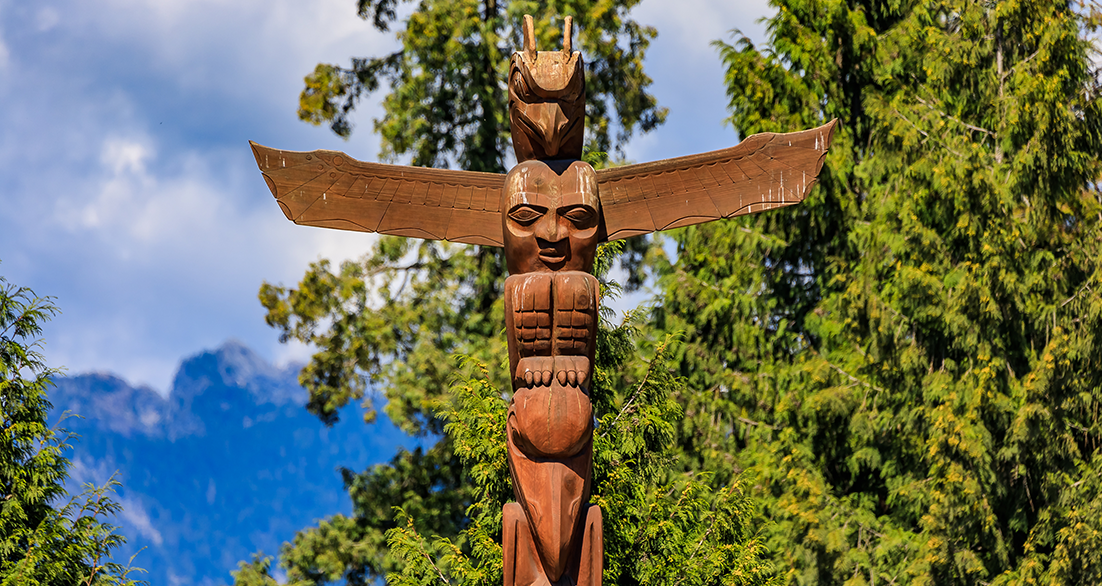
Carving a Piece into History:
The Story of the Totem Pole
We have all seen these iconic structures built around the nation. They have become a staple in American culture and continue to take the spotlight in Native American spaces. The totem pole is recognized nationwide, but little is known about its origins, purpose, and symbolism. You’ve seen them in movies, books, and museums. However, these commemorative structures are a great achievement in native art and hold a special place in both American and Native American history.
Totem poles originated in the tribes of the Pacific Northwest in modern-day Oregon, Washington, and British Columbia. In this region, totem poles were known as gyáaʼaang, meaning a tall, carved wooden pole depicting clan and family history. The cedar tree is highly regarded, and the forests are highly protected. Western Red Cedar is abundant in the forests of the Pacific Northwest and was a staple in tribes such as the Haida, Tlingit, Tsimshian, Kwakwaka’wakw, and the Nuu-chah-nulth community. Since the trees were abundant and robust, they originally served a more utilitarian purpose. They evolved and were used in different ways in different tribes. They grew to be instruments for storytelling and documentation.
Contrary to popular belief, totem poles were not used for religious practices. In the late 19th century, totem poles were essentially outlawed because Christian missionaries believed that Native Americans used totem poles to celebrate pagan gods. To make it easier to convert Native Americans to Christianity, they were banned and destroyed. Native Americans were pressured into disengaging from their native practices with anti-Native laws. It wasn’t until the 1930s that Native Americans were once again allowed to hold practices and ceremonies that involved totem raisings.
 There are several different types of poles, all depicting some type of narrative. Frontal house poles are located at the main entrance and have a carved-out opening for the entrance of the house. Mortuary poles commemorate the deceased and hold their ashes, and they tend to be the tallest poles. There are also “shame” poles that were used to call out members of the community for debts or other grievances. Today, they serve as political statements and forms of protest. All the different types of poles feature human-like, natural, and supernatural forms. You can see humans, birds, bears, wolves, and Thunderbirds. These are among the most recognizable motifs.
The totem pole's long history, craftsmanship, and artistry have made it an emblem of American culture, and we’re proud to honor that this Native American Heritage Month.